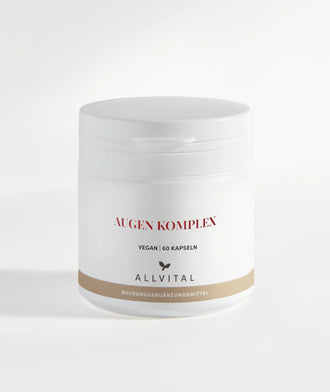

Eye Complex: Nutrient power for your vision
Our new product, Eye Complex, combines vital nutrients to support visual performance and help maintain long-term eye health.
Why you should support your eye health?
To function properly and stay healthy, the eyes require a continuous supply of micronutrients. These nutrients are essential for the visual process as well as for the structure and integrity of tissues such as the cornea, lens, and retina. At the same time, they serve as a protective shield against free radicals that are constantly produced in the eyes through light exposure and metabolic activity.
Additional stress factors such as intense UV radiation, blue light from screens, environmental pollutants, or chronic stress further increase the need for micronutrients. If these are not supplied in sufficient amounts, the long-term result may be a decline in visual performance and eye health. Increasing numbers of people experience issues such as reduced visual acuity, dry eyes, or rapid eye fatigue.
This is where our new Eye Complex comes in. It is a carefully balanced six-component formula designed to comprehensively support eye health.
Eye Complex: Unique supplement for healthy vision
Eye Complex combines all key micronutrients for the eyes in a single formulation. This eliminates the need to combine multiple products, as the six essential nutrients are brought together here in optimally balanced form.
Each daily dose of two capsules provides:
- 110 mg vitamin C (from magnesium ascorbate)
- 60 mg anthocyanins (from black currant)
- 20 mg lutein (from marigold)
- 4 mg astaxanthin (from Haematococcus pluvialis)
- 4 mg zeaxanthin (from marigold)
- 6000 I.U. vitamin A
These six ingredients have been combined and dosed to complement one another, forming a well-rounded formula that provides comprehensive nutritional support for the eyes.
The ingredients in detail
Below you can find how each component of Eye Complex contributes to maintaining healthy eyes.
Vitamin A – the classic “eye vitamin”
Vitamin A plays a key role in the visual process. In the retina, it is required for the formation of rhodopsin, a pigment found in the rod cells that enables night and low-light vision. A deficiency in vitamin A may therefore lead to difficulties adapting to dim light or even night blindness.
In addition, vitamin A helps maintain the health of the cornea and conjunctiva. It supports the integrity of the mucous membranes, helping to keep the eye surface properly lubricated. Insufficient vitamin A can result in dryness, irritation, or degenerative changes to the cornea.
Vitamin C – natural protection against oxidative stress
Vitamin C is one of the most important antioxidants in the eyes. It neutralizes free radicals generated by light and metabolic activity, helping to protect delicate structures such as the retina, lens, and blood vessels from oxidative stress. The concentration of vitamin C is particularly high in the lens and aqueous humour.
Moreover, vitamin C is essential for collagen formation, the structural protein that gives blood vessels and connective tissue in the eyes their strength and stability. Another advantage: vitamin C can regenerate other antioxidants, such as vitamin E, thereby prolonging their activity.
In Eye Complex, vitamin C is provided as magnesium ascorbate, a buffered and well-tolerated form that ensures optimal bioavailability.
Lutein and zeaxanthin – pigments of the macula
Lutein and zeaxanthin are yellow plant pigments belonging to the carotenoid family. They are concentrated in the macula, the central region of the retina responsible for sharp vision. The macula is also known as the “yellow spot,” a name that reflects its high content of these pigments.
Both carotenoids act as natural filters by absorbing high-energy blue light and by contributing to the antioxidant defence system. Their dual role as light filters and radical scavengers makes them essential for protecting the macula from light-induced damage. Adequate intake of lutein and zeaxanthin is therefore considered important for maintaining visual performance over time.
Astaxanthin – powerful antioxidant from microalgae
Astaxanthin is a reddish carotenoid produced by various microorganisms. The most important natural source is the microalga Haematococcus pluvialis, which forms large amounts of this pigment under stress conditions such as intense sunlight or nutrient deficiency. Through the food chain, astaxanthin is also found in marine organisms such as krill, salmon, or lobster – and even the pink colour of flamingos comes from astaxanthin-rich food sources.
Unlike lutein and zeaxanthin, astaxanthin is not one of the macular pigments. However, it has a special property: it can cross the blood-retinal barrier and act directly within the eye. This ability makes it particularly interesting for research, and astaxanthin is currently being studied for its potential in various eye-related conditions.
Anthocyanins from black currant
Black currants are naturally rich in anthocyanins – plant pigments that give the berries their deep purple colour. These secondary plant compounds belong to the polyphenol group and are found in many dark-coloured fruits. They have long been valued for their relevance in nutrition and scientific research. In Eye Complex, the anthocyanins are derived from a high-quality black currant extract.
Who can benefit most from Eye Complex?
Eye Complex is suitable for a wide range of individuals. It may be particularly relevant for:
- People who spend long hours in front of screens – at work, gaming, or on smartphones
- Older adults whose natural visual protection may decline with age
- Individuals frequently exposed to sunlight or environmental pollution
- People with a family history of age-related eye problems such as AMD
This makes Eye Complex an ideal choice for anyone – from professionals to seniors to health-conscious individuals – who wish to proactively support their visual health.
How to take Eye Complex?
The recommended daily dose is two capsules, preferably taken with meals. This supports the absorption of the fat-soluble components such as vitamin A and the included carotenoids.
Possible side effects and interactions
The nutrient levels in Eye Complex fall within the typical range of dietary supplements and are considered safe and well tolerated for healthy adults. No side effects or interactions are known.
As a general recommendation, dietary supplements should be used under professional guidance, and relevant laboratory values should be checked regularly.
Is the amount of vitamin A safe?
The included dose of 6000 I.U. corresponds to approximately 1800 µg retinol equivalents per day. This amount remains below the upper safe limit for adults established by the European Food Safety Authority (EFSA) of 3000 µg per day (equivalent to 10,000 I.U.).
In holistic medicine, a daily intake of vitamin A in the range of 5000 to 10,000 I.U. is commonly considered appropriate, including for pregnant and breastfeeding women. To prevent excessive intake, it is advisable to check whether other supplements being used also contain vitamin A.
Sources
- Yang M, Wang Y. Recent Advances and the Mechanism of Astaxanthin in Ophthalmological Diseases. J Ophthalmol. 2022;2022:8071406. Published 2022 May 20.